
Brand rollout, online brand book and website for an accounting service that runs FOP paperwork for freelancers.
Overview
Startax
Startax runs the bookkeeping of Ukrainian sole proprietors (FOP) — taxes, reports, reminders and talking to the tax office — with automation doing the routine and real accountants checking it. After years of B2B work for 10,000+ couriers and drivers, the team turned to the digital economy: developers, designers, freelancers on Upwork and Fiverr. At Nadra Studio we took the project from the brand to the live site. The identity — the Startax wordmark, the Stx. monogram, the lime and the strips — was made by my Nadra colleague Yulia. I turned her concepts into design tokens and a web presentation, carried the brand onto its touchpoints, shared the art direction with her, built the online brand book, animated the system, and designed and built the website.
Role
Web Designer & Developer, co-Art Director — Nadra Studio
Year
2026
Client
Startax
Scope
Web · Brand · Motion

The website
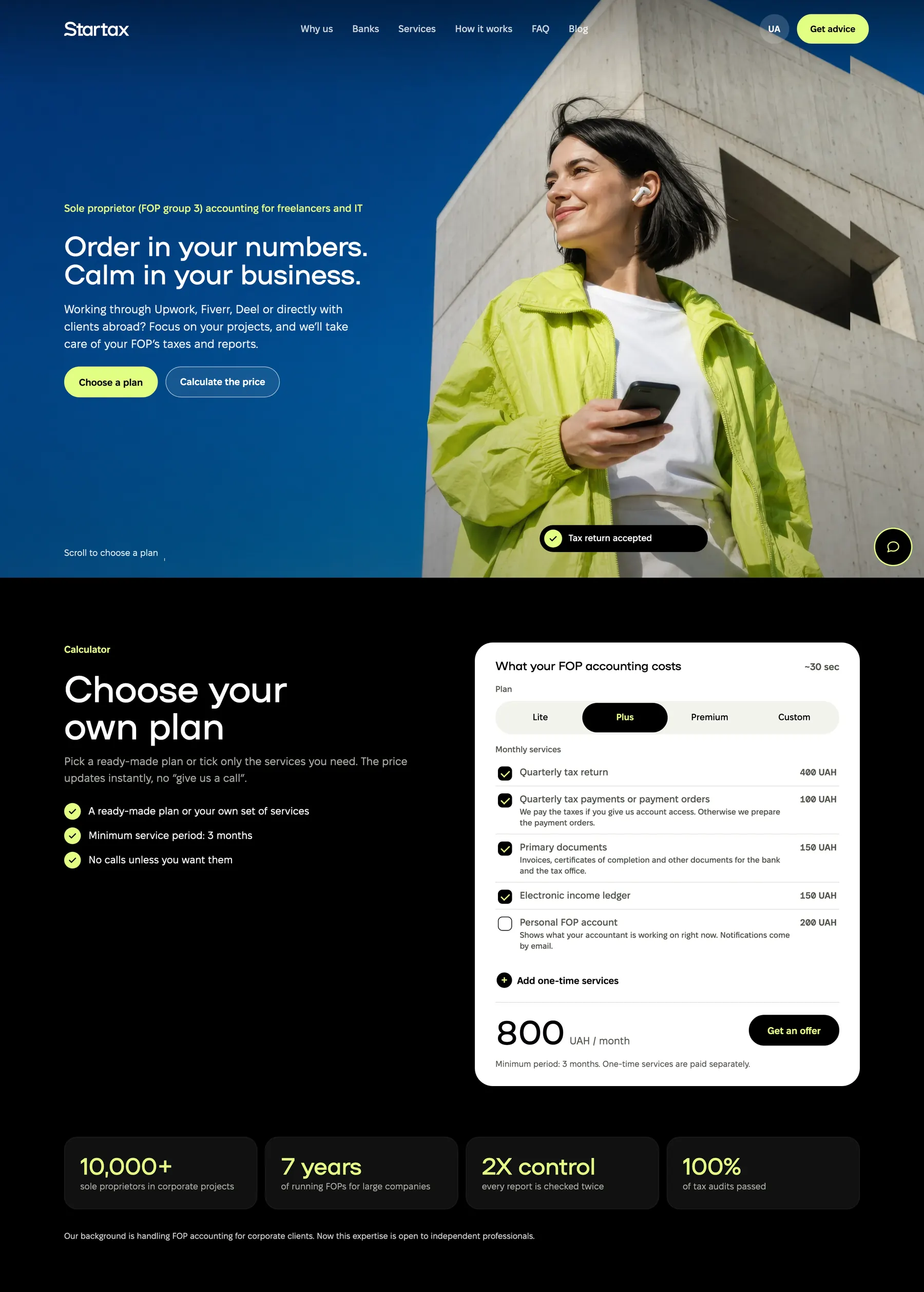
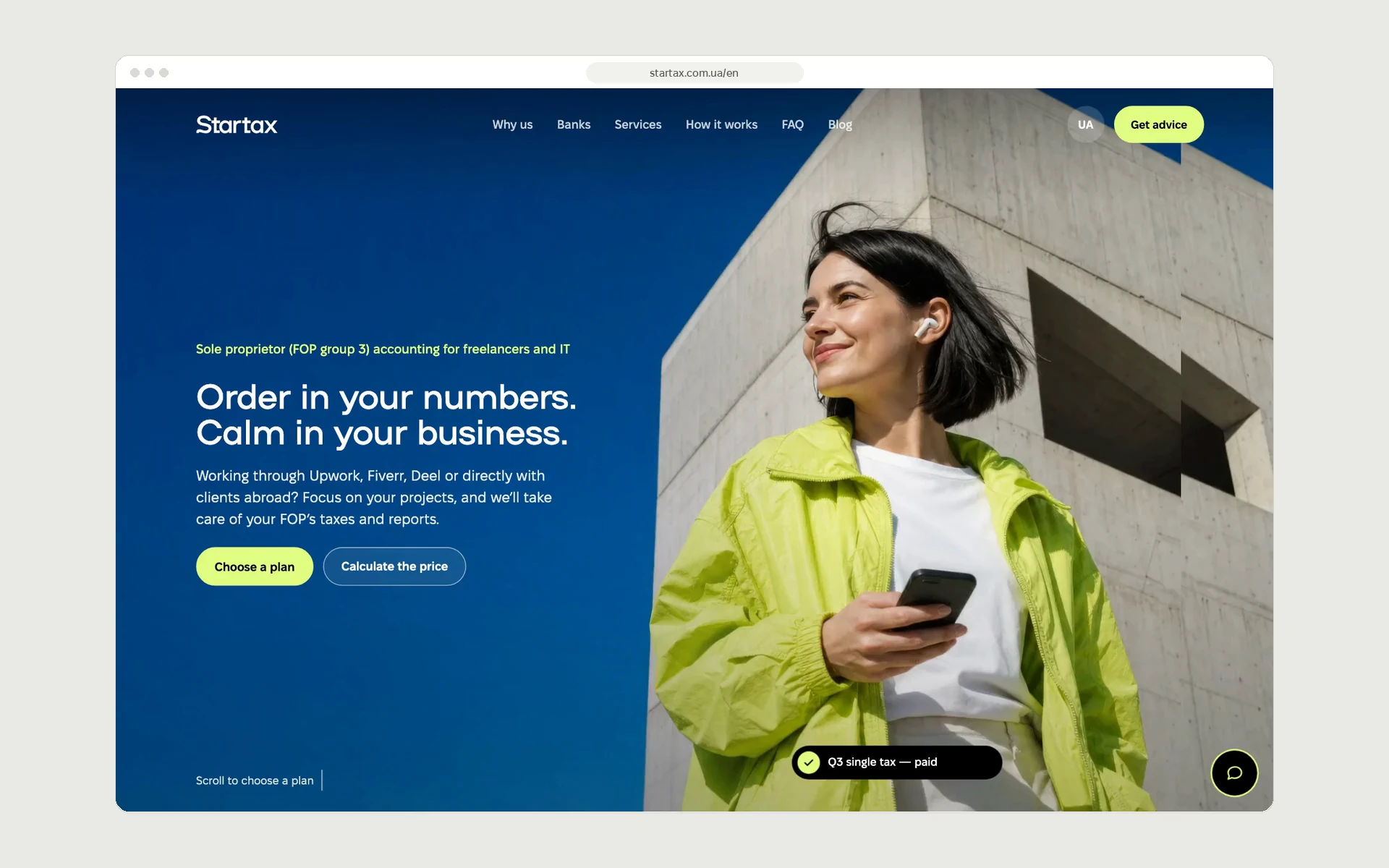
A financial service that reads like a modern product.
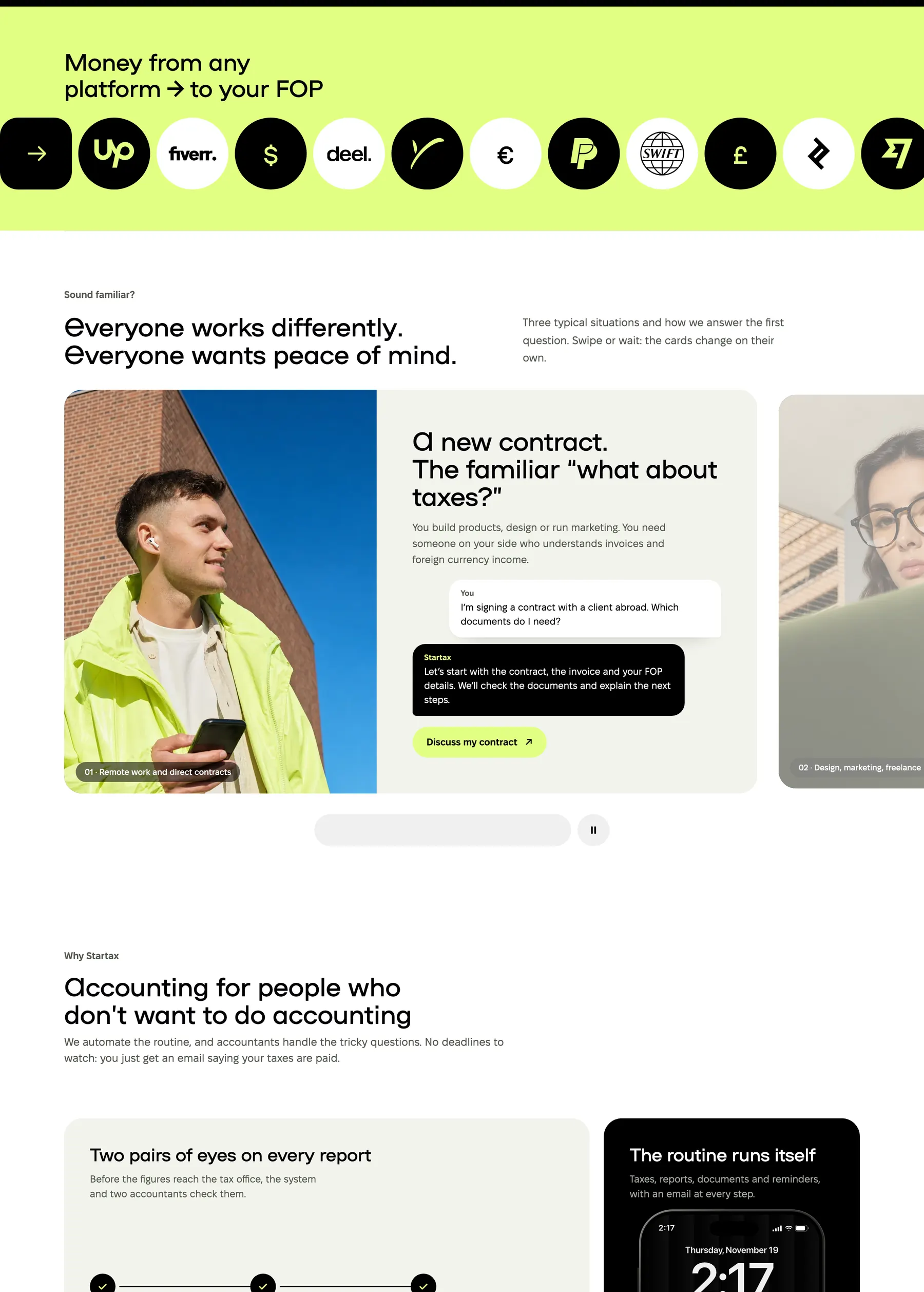
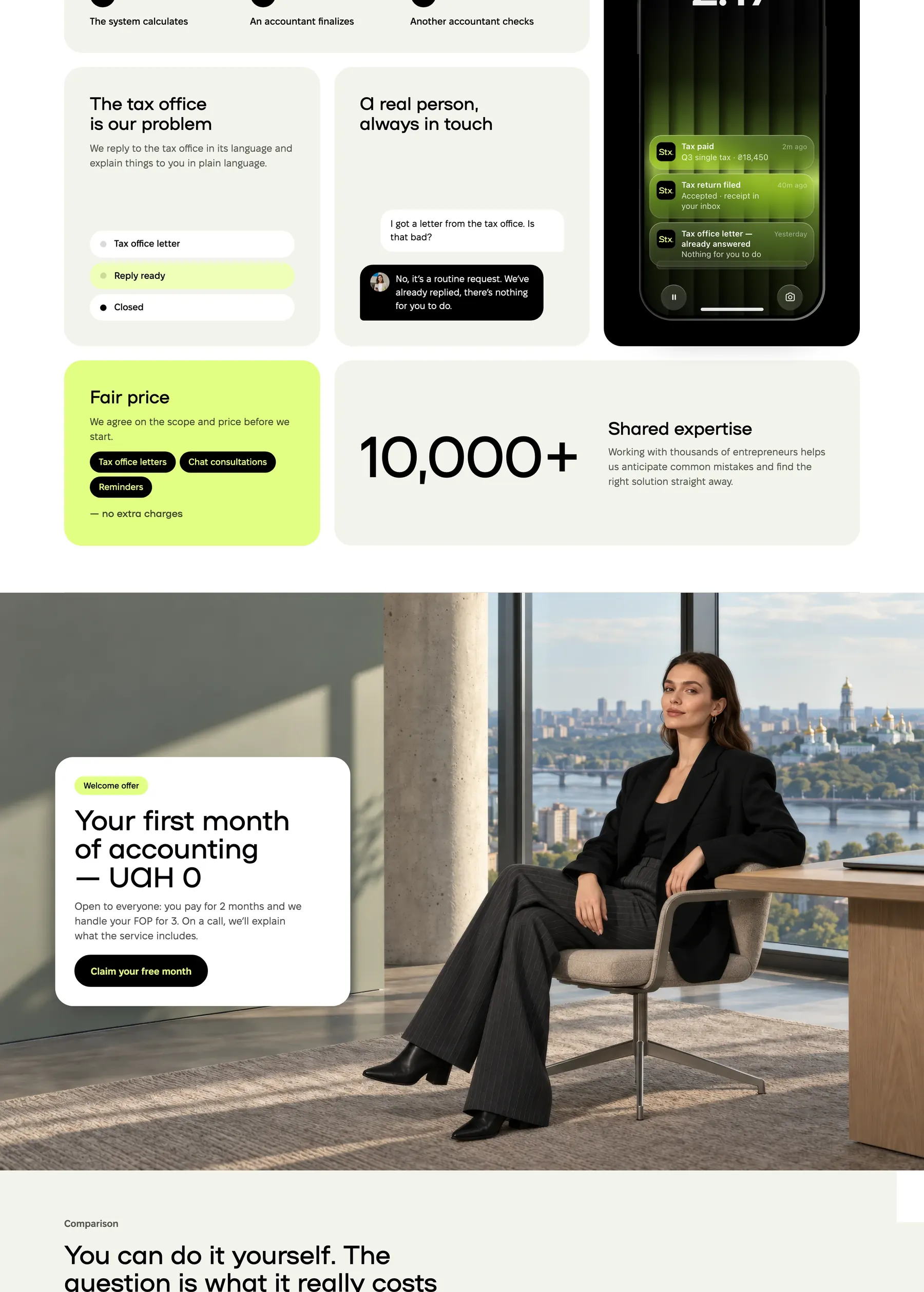
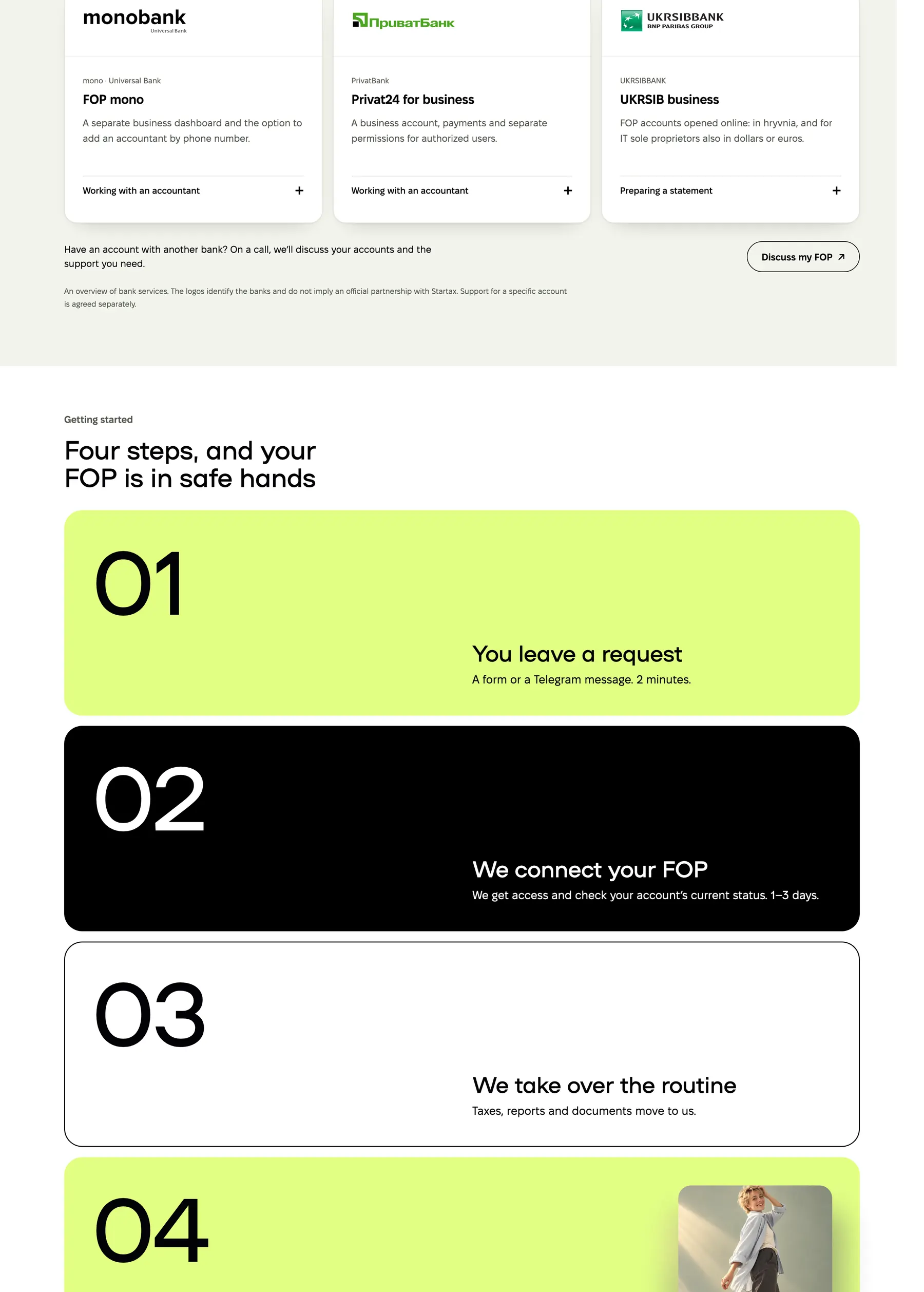
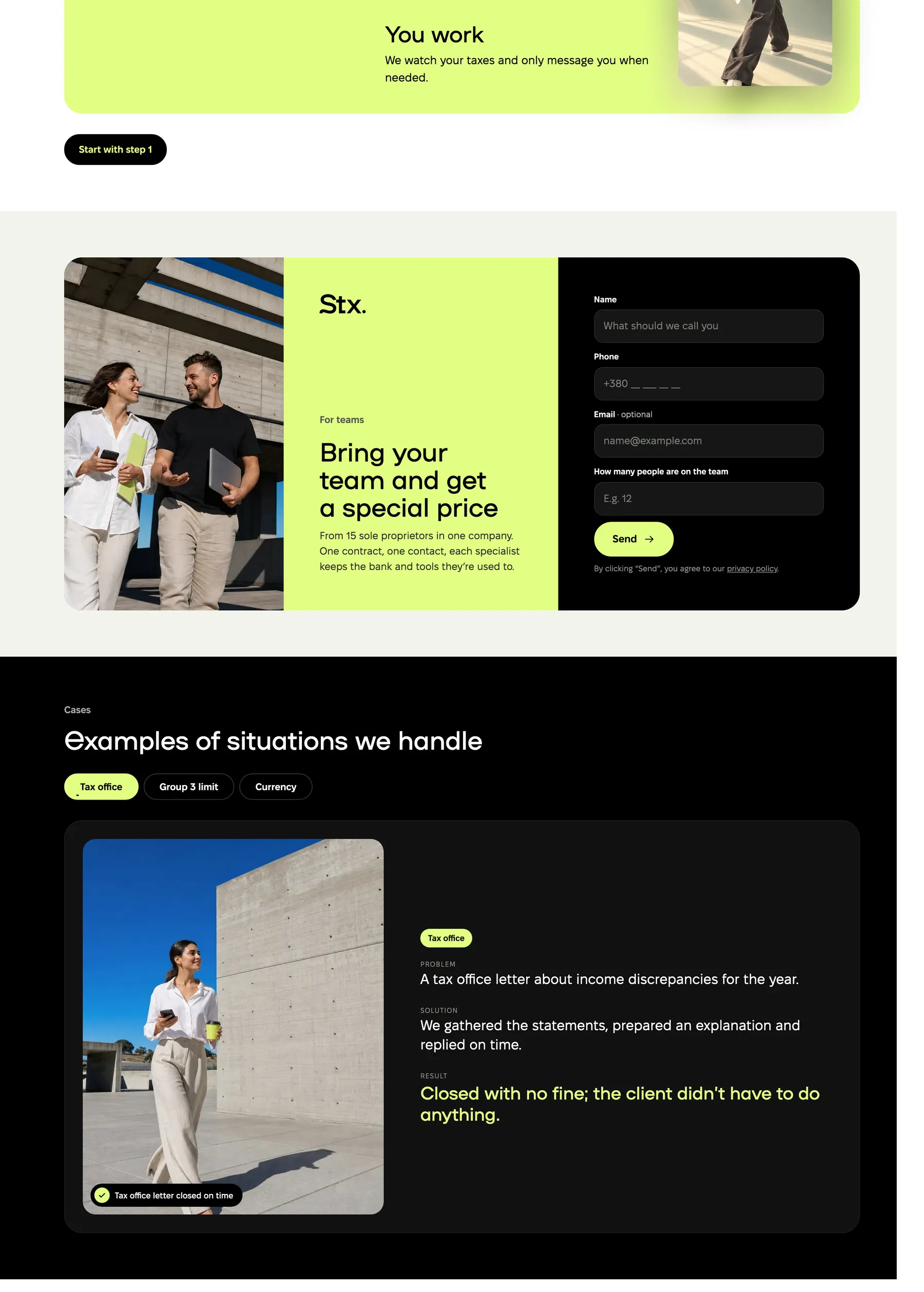
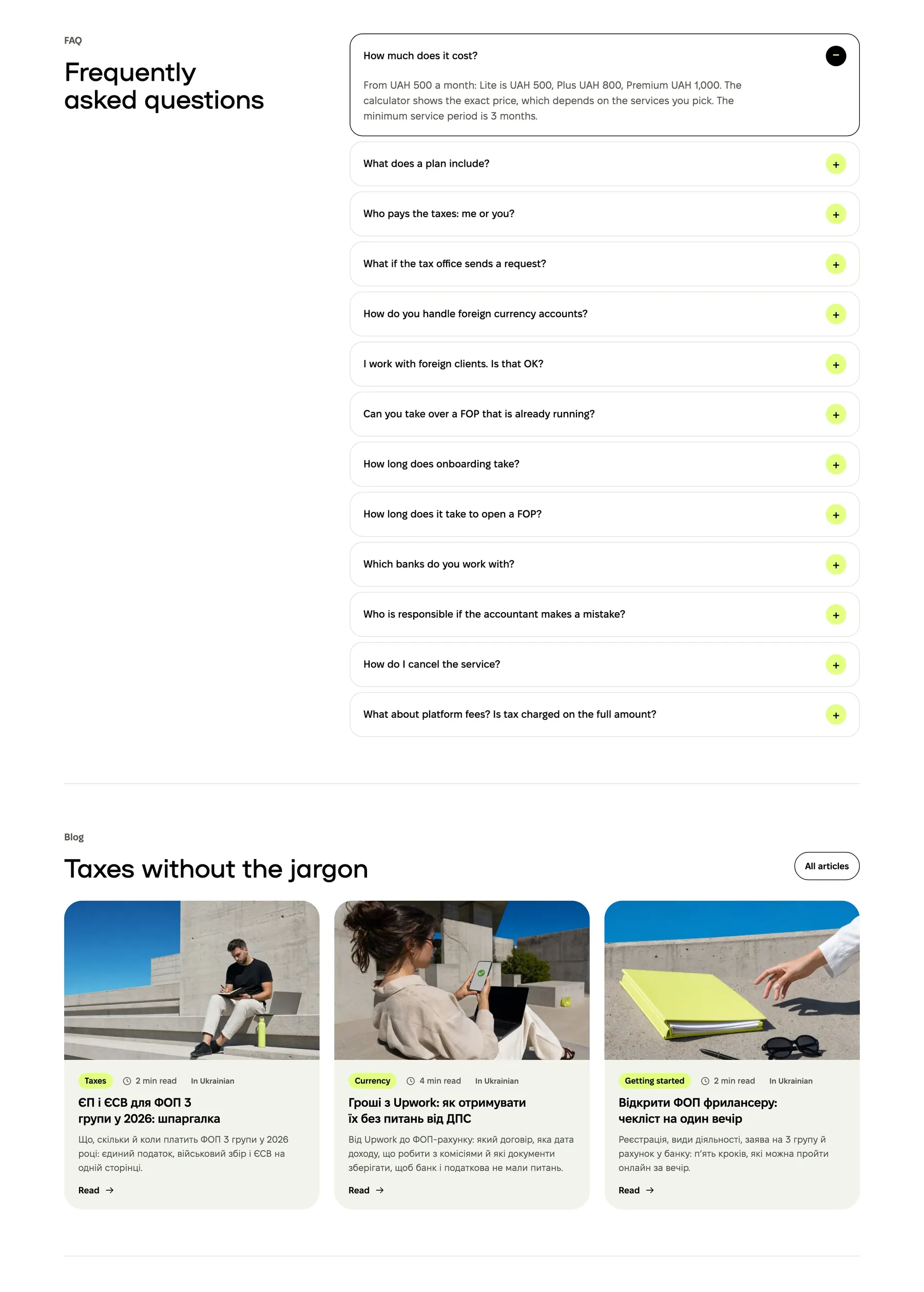
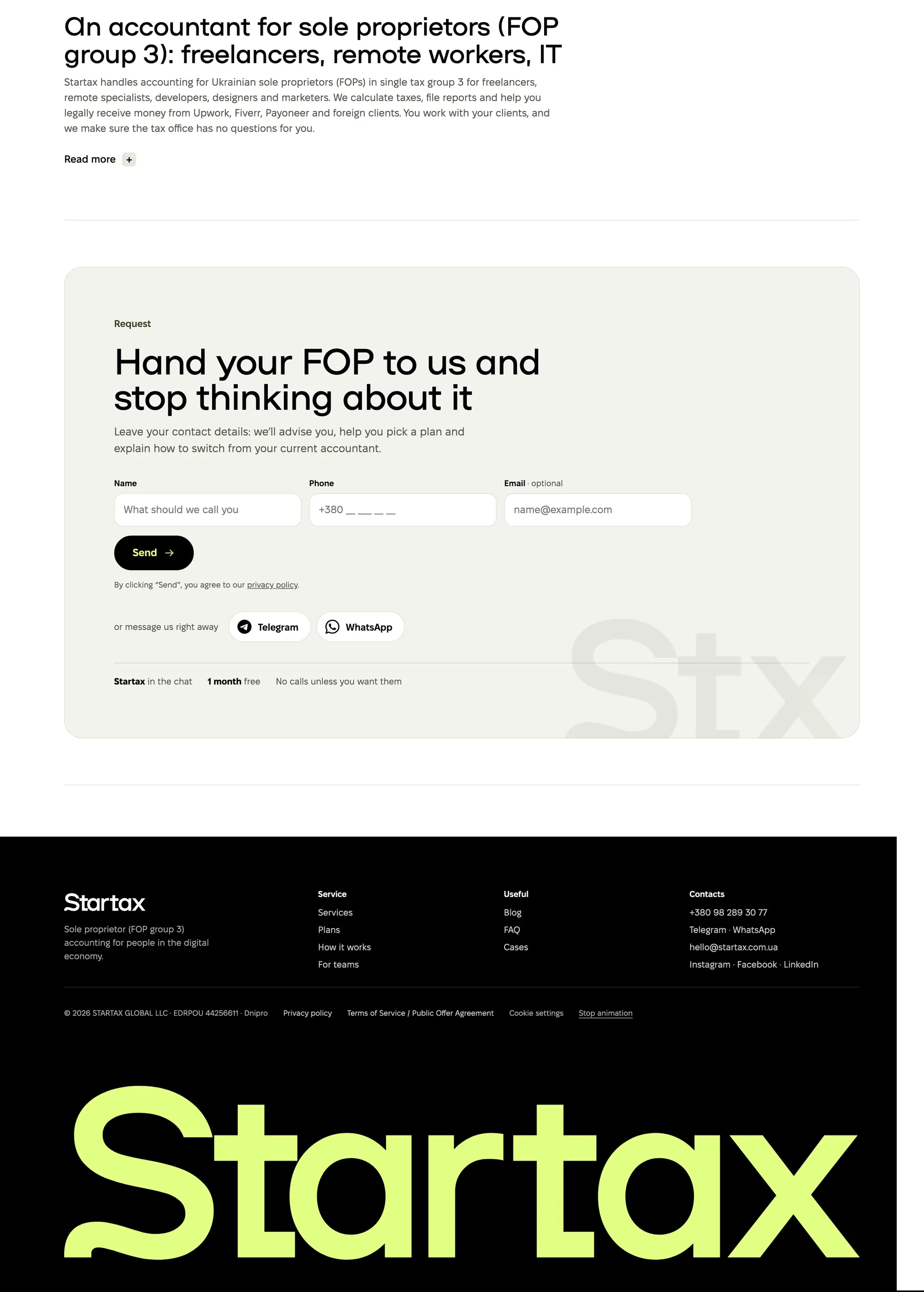
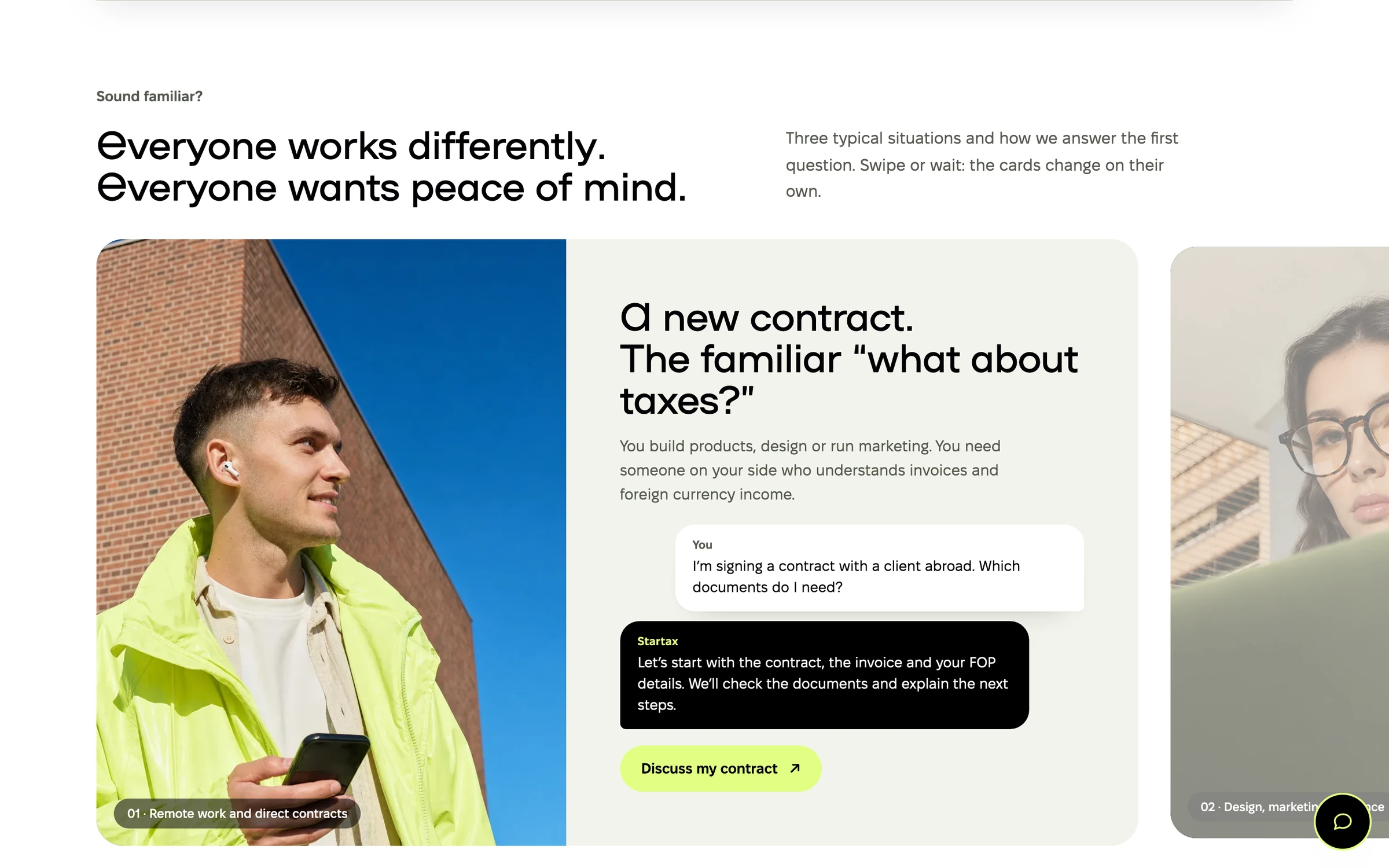
The audience can run a FOP themselves — the real question is why they would spend their time on it. Accounting brands answer with jargon, calculator icons and stock photos of people in suits. Startax had to feel like a fintech product and still earn the calm trust a financial service needs: no folders, no rubber stamps, no clichés.
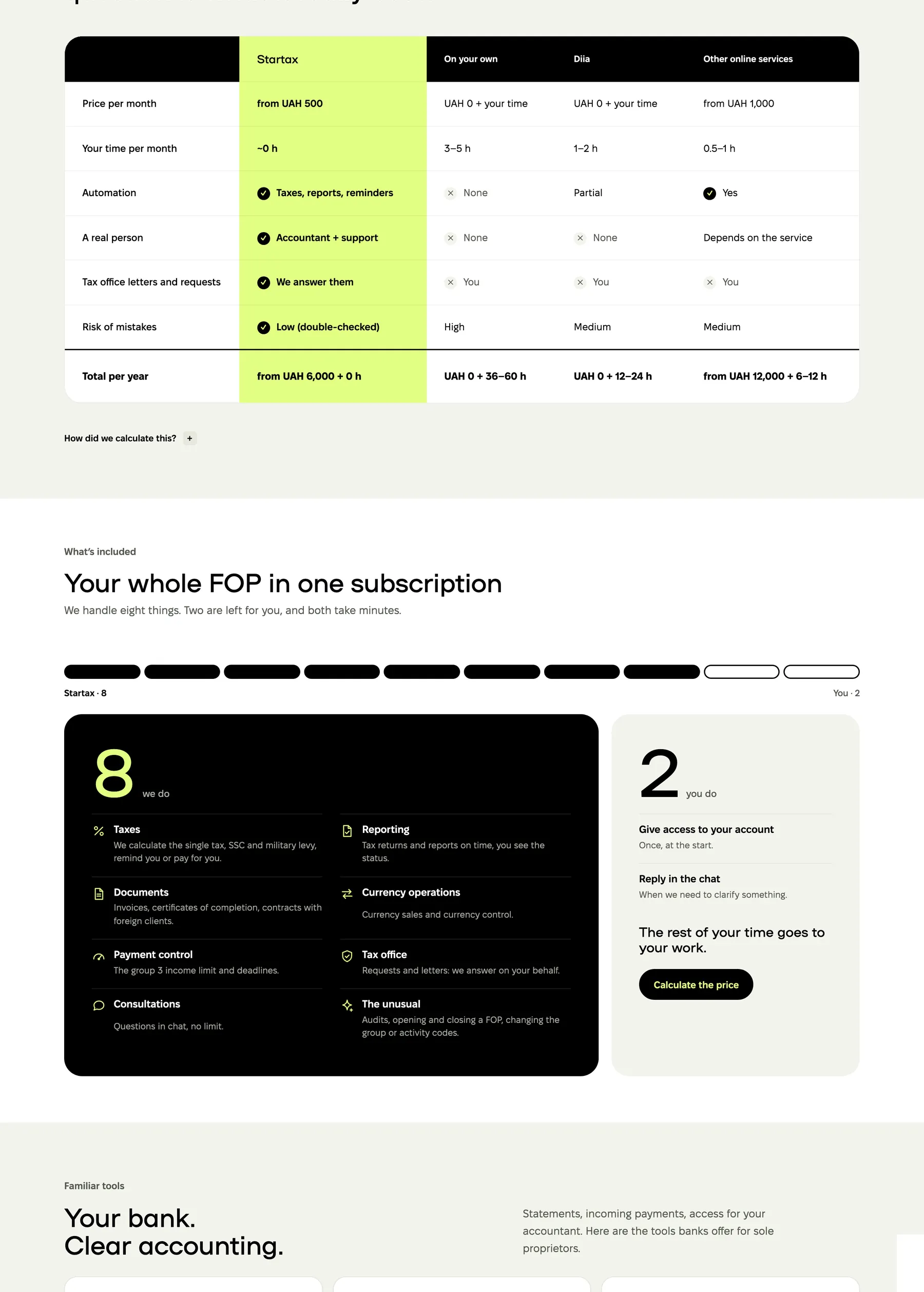
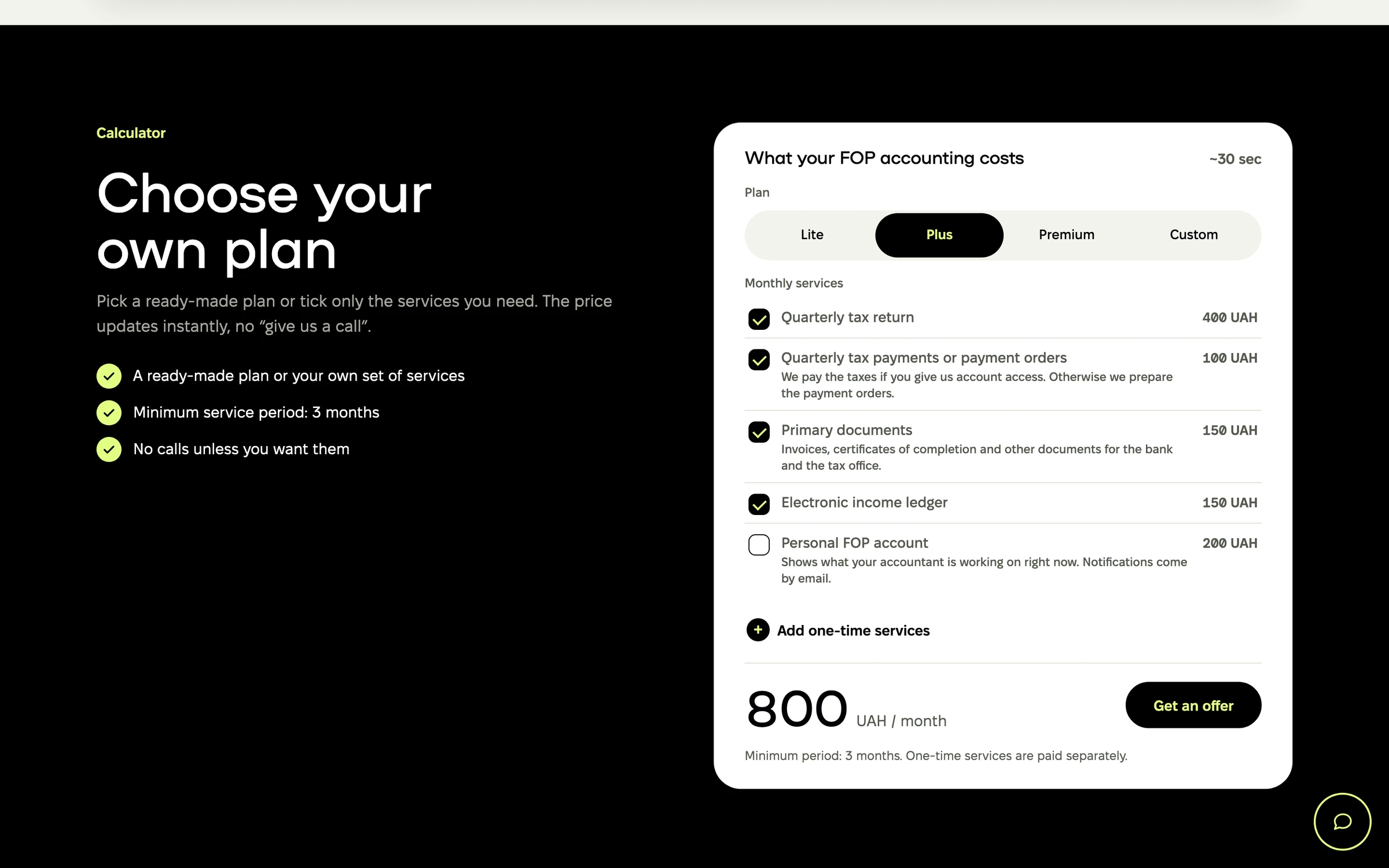
The site was mine end to end. The single KPI was qualified leads, so every block points to one action: the price is visible on the first screen, the calculator works out a plan in a few taps, and the form is a light sheet with two required fields instead of a page-long questionnaire.
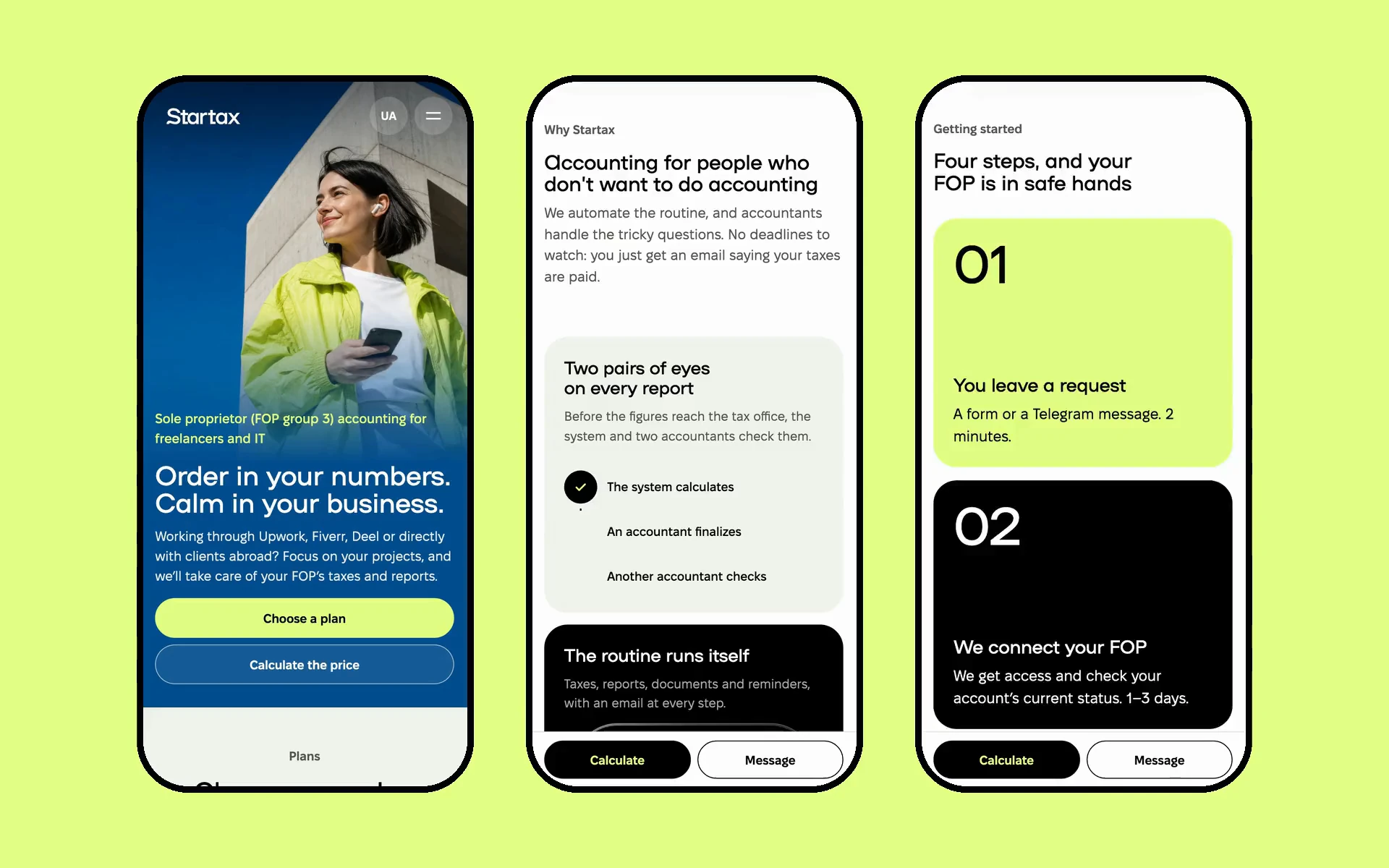
On desktop the very first scroll slices the hero photo into strips that become the three plans — the same move the brand is built on, more on that below. Built mobile-first in Astro, in Ukrainian and English, static and light, so it could pass Core Web Vitals without a heavy CMS behind it.
The calculator
One tariff source, prices everywhere.
At the heart of the site is a live price calculator: a ready plan — Lite 500, Plus 800, Premium 1,000 UAH a month — your own set of services, or one-off jobs. The plans, the calculator, the comparison table, the FAQ and the structured data all read from a single tariff file, so a price changes once and updates everywhere.
Lead forms go straight to NetHunt CRM and email, with spam protection and rate limits, and they stay accessible and work even without JavaScript.
From concepts to a presentation
Three brand concepts, each one already a working website.
Yulia drew three identity concepts. Before the client saw any of them, I described each one as a set of design tokens — colour, type, spacing, radii, the photo treatment — and built a web presentation where every concept came with its own draft of the site. The drafts had OpenAI integrations built in; I wrote part of the prompts myself and ran the rest through an agent orchestrator.
On top of Yulia's base I carried each concept onto touchpoints and laid out the deck. We then reviewed and corrected it together and presented it to the client. They chose a hybrid: the logo from the third concept, the lime and the dynamic style from the first.
The idea
Order in the numbers.
Accounting is the moment scattered papers fall into place. The brand turns that into a graphic technique: a photo is sliced into vertical strips that shift and come back together, like the columns of a ledger. I animated the strips — on screens they open, hold and fall back into place, a little out of step, like pages being sorted. The strips never cut across a face.
A wordmark, a monogram, a lime and two typefaces.
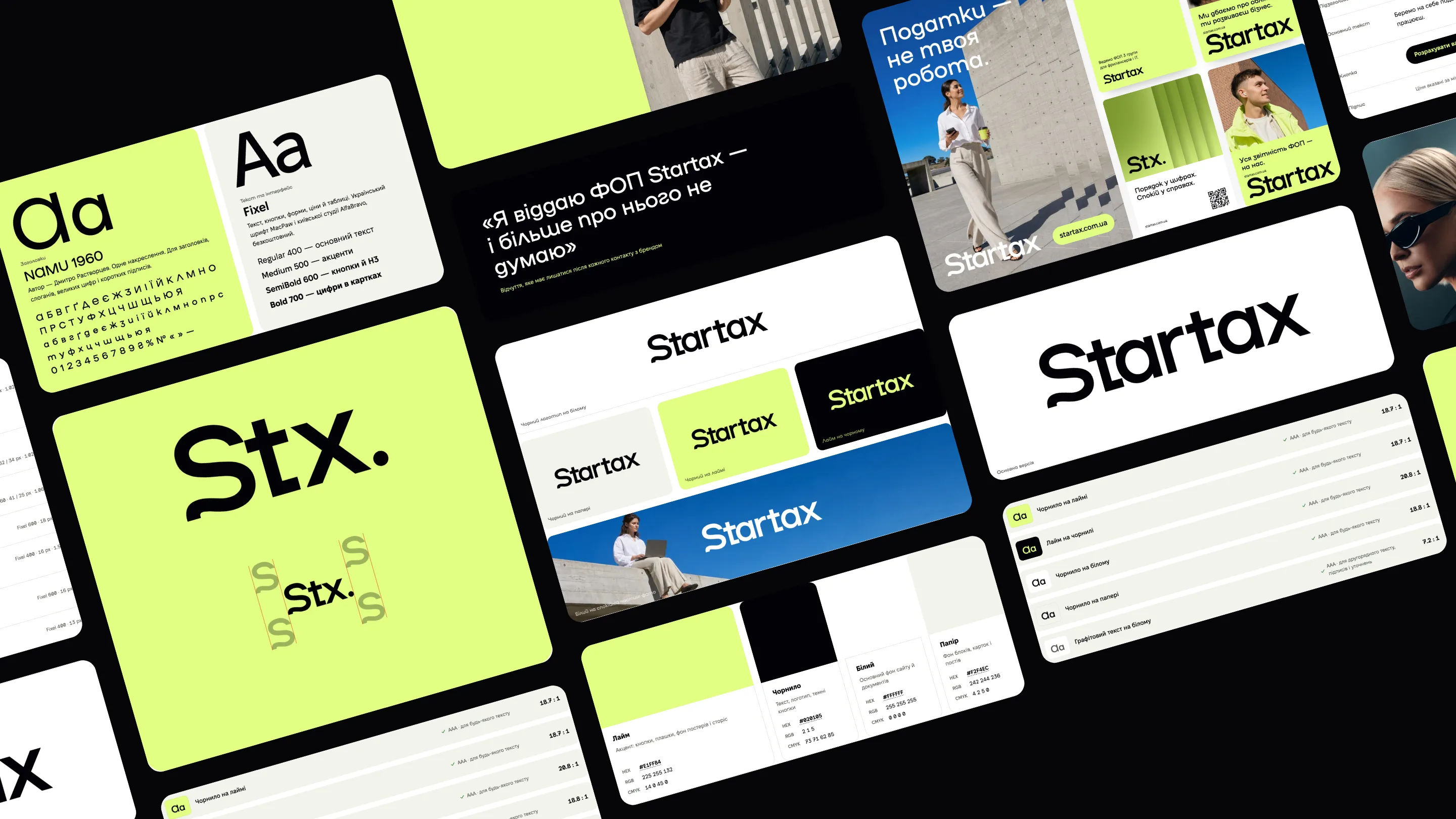
A confident wordmark, Startax, and a compact Stx. monogram for avatars, the favicon and the app icon — only the monogram keeps its full stop. Headlines are set in NAMU 1960 by Ukrainian type designer Dmytro Rastvortsev, everything people read and tap in Fixel. A sharp lime #E1FF84 on pale grey and ink: bright enough for a feed, restrained enough for numbers and contracts.
The online brand book
The whole system on one page.
With the tokens and the presentation already in place, putting the brand book together was the easy part. I built it as a website with AI agent skills — some off the shelf, some I wrote for this project: tone of voice, the logo and its misuses, colour with contrast ratios, type, the strips, photo style and every carrier. Logos, avatars and palettes download straight from the page, and there are ready prompts for new photos in the house style.
In the city and in the feed
Testing the system where people actually meet it.
A poster is a photo or lime across the whole sheet, a short headline and the logo. On metro screens and in digital ads the strips move; on paper they hold as one frame. Stories speak in the same voice: a poll about the tax return, a price calculator, a deadline reminder.


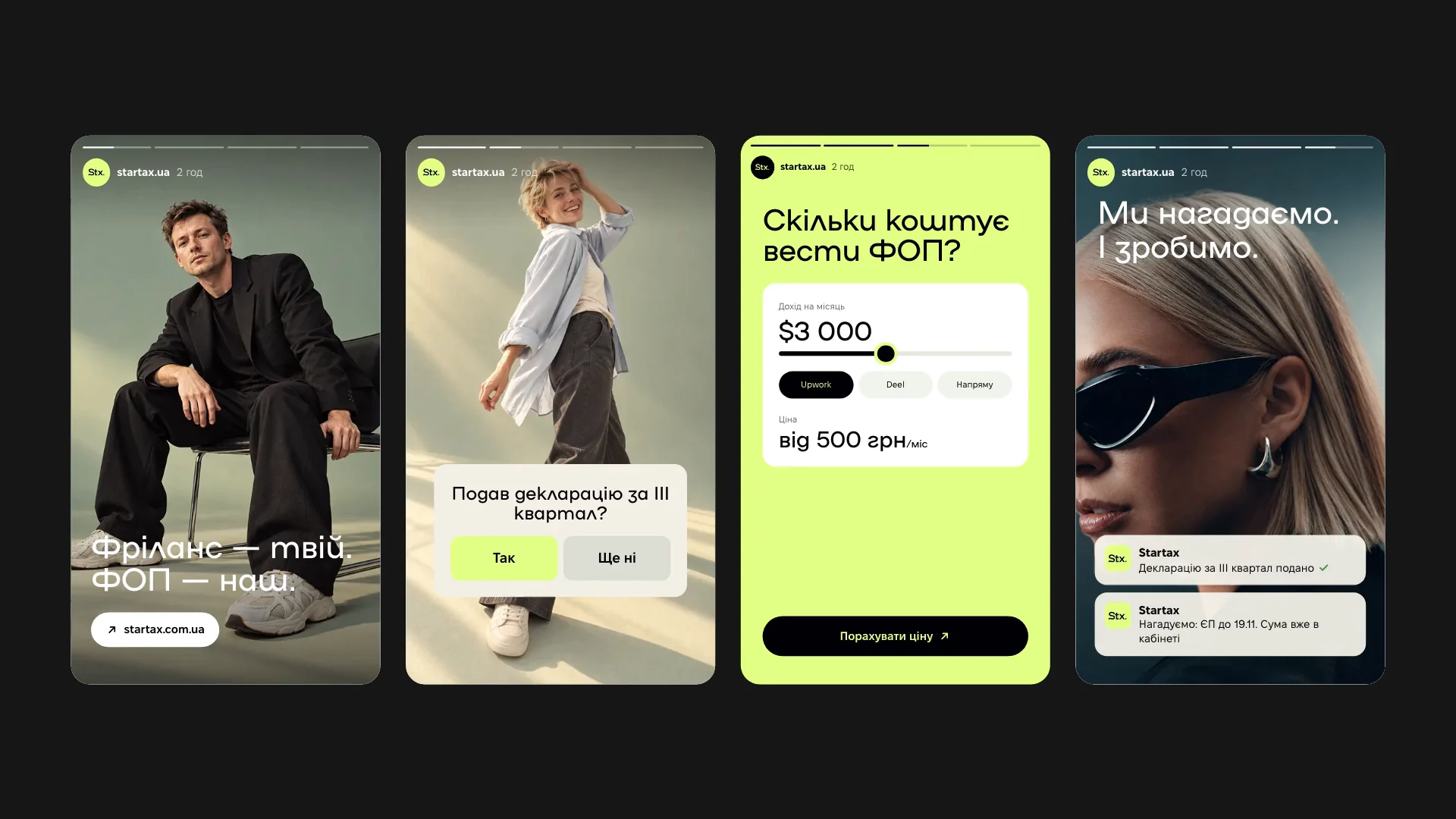
Layouts from the client presentation, shown as mockups. Lifestyle photos are AI-generated under our art direction, not a photo shoot.
On paper and in hand
Off the screen, the same rules.
Business cards, a letterhead, an invoice and a compliments card; a lime folder with a Stx. tab, a tote dyed in strips, a notebook. No shadows, no black-and-white photos — the same rules as on screen.
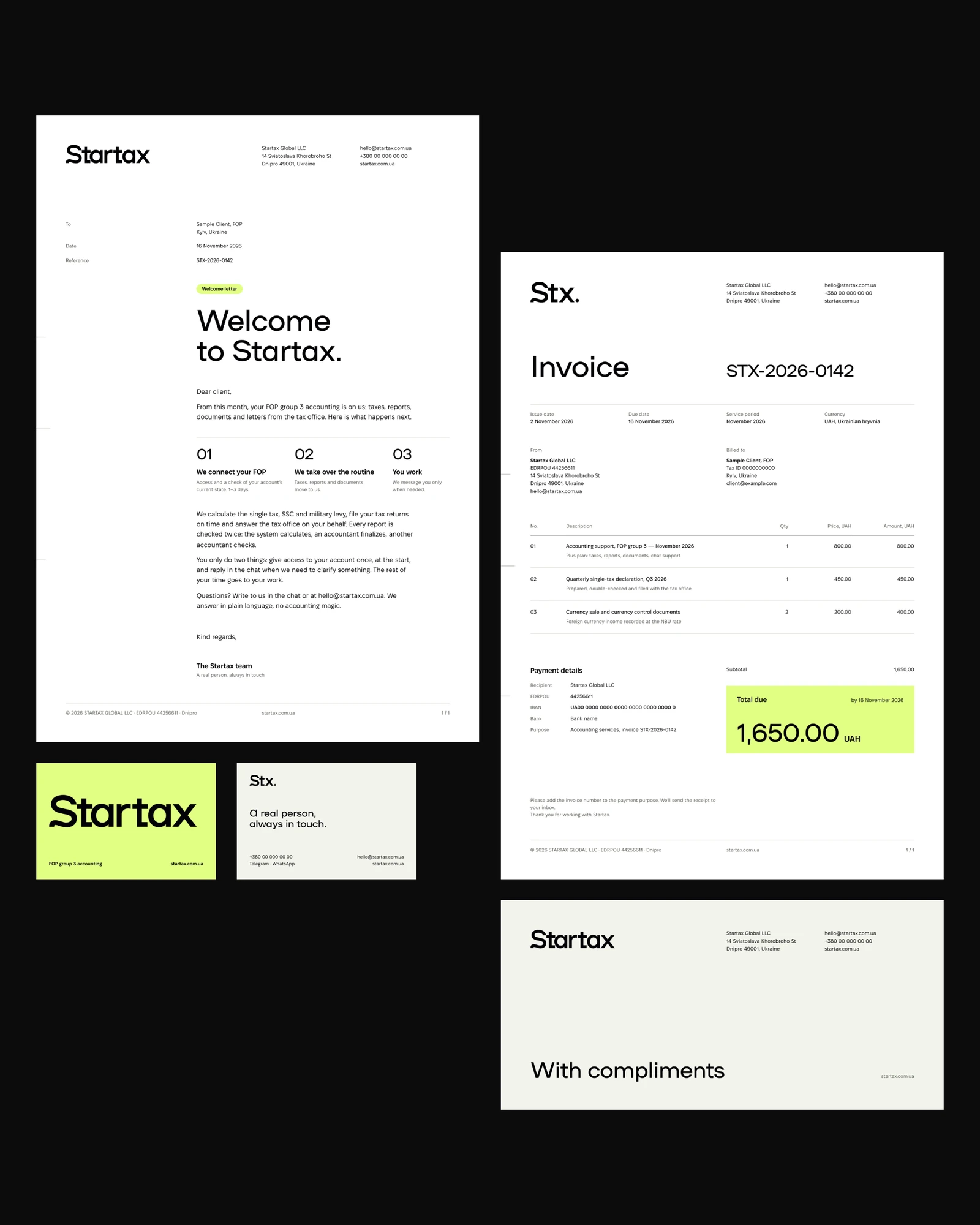
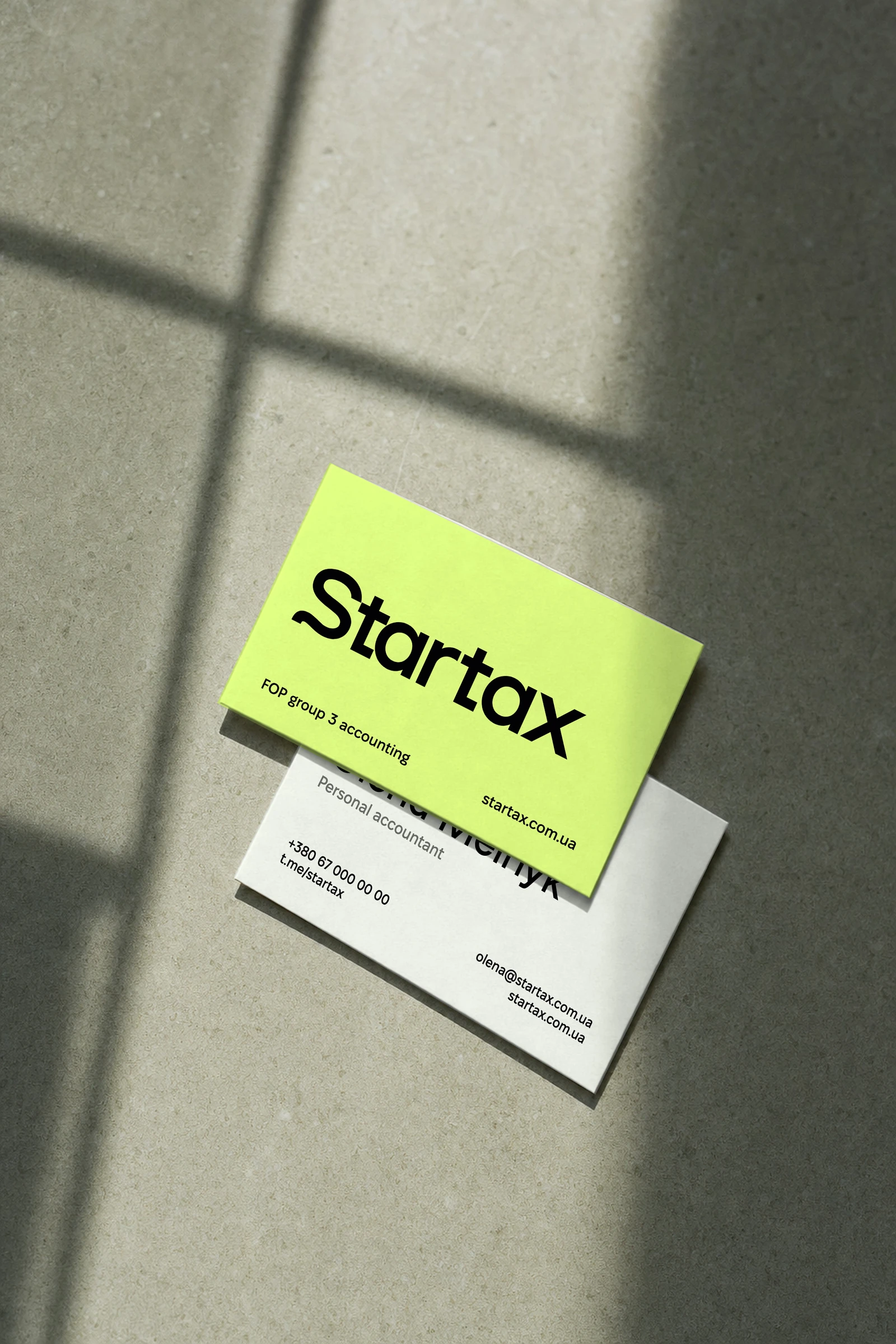
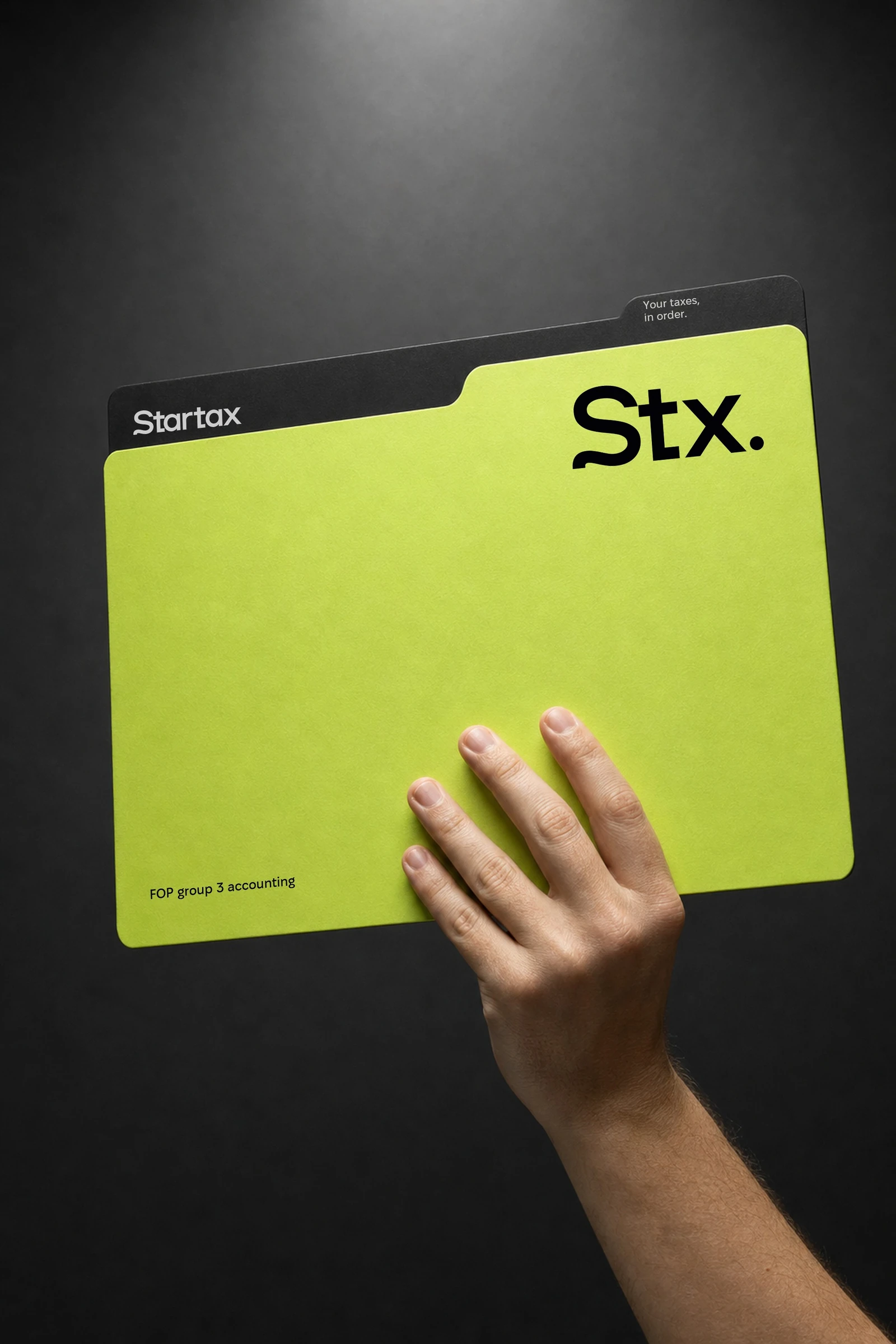

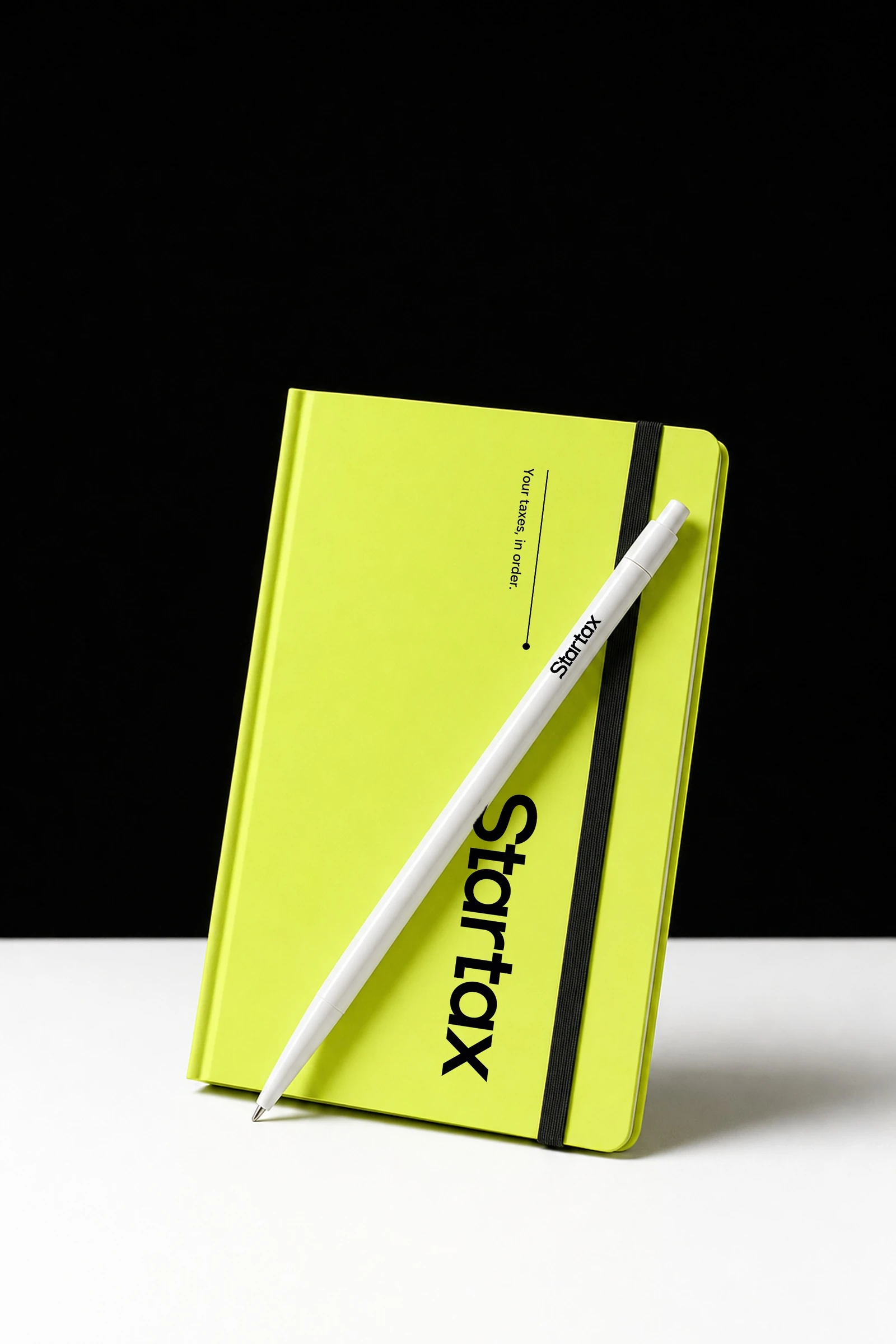
Mockups: the exact layouts placed on generated base images. Nothing here has been printed yet.
What I delivered
01
Design tokens and a web presentation for three brand concepts, with site drafts for each
02
Brand rollout onto touchpoints — posters, metro, stories, print and merch mockups
03
Shared art direction of the photo style and the case
04
Online brand book, built with AI agent skills
05
Strips animation for the web, reels and the case film
06
Website design and development — Astro, UA + EN, mobile-first
07
Live price calculator from a single tariff source
08
Lead forms → NetHunt CRM + email, working without JavaScript
Outcome
Brand rollout, online brand book and website for an accounting service that runs FOP paperwork for freelancers.
Startax runs the bookkeeping of Ukrainian sole proprietors (FOP) — taxes, reports, reminders and talking to the tax office — with automation doing the routine and real accountants checking it. After years of B2B work for 10,000+ couriers and drivers, the team turned to the digital economy: developers, designers, freelancers on Upwork and Fiverr.